Sophia Learning vs StraighterLine
Sophia and StraighterLine both earn ACE credit, but they price and test in opposite ways. Here's which one actually saves you money and time.

Sophia Learning vs StraighterLine: The Short Answer
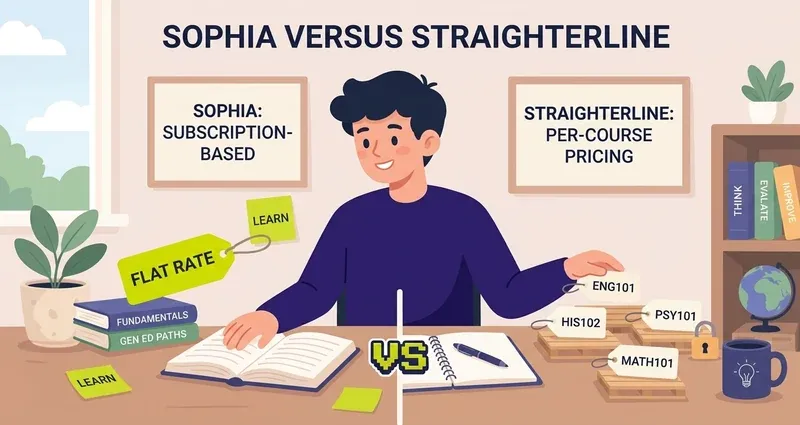
Sophia Learning and StraighterLine are the two heavyweights of self-paced, ACE credit-recommended online college courses. Both let you earn transferable credit on your own schedule for far less than a traditional university charges. Both are widely accepted at partner schools. If you're deciding between them, you're choosing between two genuinely good options — but they differ in two ways that matter a lot.
The two decisive differences are how you pay and how you're tested:
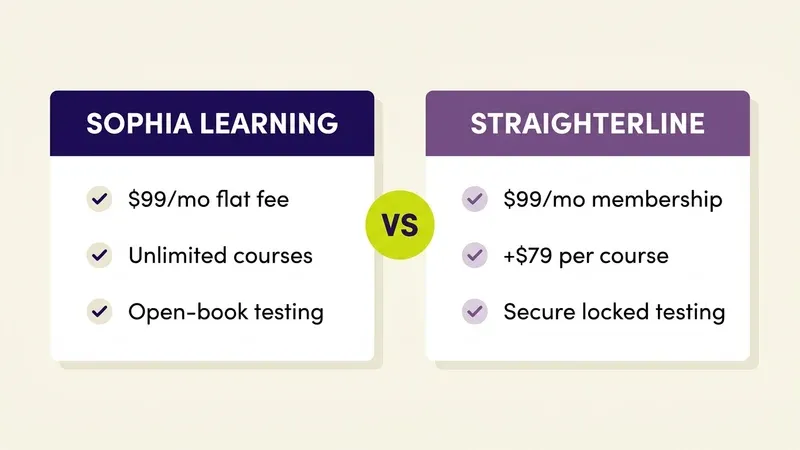
- Sophia charges a flat $99/month for unlimited courses and uses open-book, unproctored assessments.
- StraighterLine charges a monthly membership plus roughly $79 for each course you take, and uses a secure, locked-down testing environment rather than an open-book one.
Let's break down pricing, testing, catalog, and accreditation so you can pick the one that fits how you actually study.
Pricing: Flat Unlimited vs. Membership Plus Per-Course
This is where the two models split most clearly.
- Sophia is a single flat fee: $99/month, month-to-month, with unlimited courses included. Take one course or take five in a month — the price is the same. There are no per-course charges.
- StraighterLine uses a two-part price: a monthly membership of about $99 plus a fee of roughly $79 for each individual course you enroll in. The membership keeps your account active; the per-course fee unlocks each class.
What this means in practice depends entirely on your pace. If you plan to knock out several courses quickly, Sophia's flat fee is dramatically cheaper — five courses in a month is still just $99. If you only need one or two specific courses and prefer to spread them out over time, StraighterLine's à-la-carte structure can make sense, since you pay for exactly what you take.
The real question isn't which platform is cheaper — it's whether you're a bulk shopper or an à-la-carte shopper, because that's what actually decides which price wins.
Testing: Open-Book vs. Secure Environment
The second big difference is the testing experience.
Sophia's assessments — Challenges and Milestones — are open-book and unproctored. There's no webcam requirement and no proctoring software on any Sophia assessment. Milestones are multiple-choice, retakable, with your highest score kept. (Sophia's Touchstones are written, human-graded projects that are plagiarism-checked — a separate format from the multiple-choice assessments.)
StraighterLine does not use live proctoring today either, but its exams run in a secure, locked-down testing environment rather than an open-book one — a more controlled setup than Sophia's open-note model. If you value the reassurance of a stricter testing environment, that's a point in StraighterLine's favor; if you'd rather work open-book at your own pace, Sophia's model is the more relaxed of the two.
How the Assessments Actually Work
It helps to know what's behind each platform's "testing environment" label, since the terms get used loosely.
Sophia courses are built from short Challenges as you move through the material, then one graded, multiple-choice Milestone per unit — retakable, with your highest attempt kept. Some courses also include a Touchstone: a written, human-graded project that's plagiarism-checked and can't be retaken the same way, which is why it's treated separately from Challenges and Milestones.
StraighterLine coursework builds toward a final exam per course, run inside a locked-down browser environment rather than an open-book one — the kind of setup that typically restricts other tabs, copying text, or outside resources while the clock runs. It's not live proctoring, but it's noticeably more controlled than an open-book Milestone.
The practical takeaway: reference-while-you-answer learners fit Sophia's model; closed-book, traditional-exam learners fit StraighterLine's.
Course Catalog
StraighterLine offers 70-plus courses and promotes acceptance at a large number of colleges. Sophia offers a broad self-paced catalog as well, heavily weighted toward the general-education and lower-division courses most students use to accelerate a degree.
For most transfer-credit seekers, both catalogs cover the core requirements — English, math, science, social sciences, business basics. The deciding factor is usually whether one platform carries a specific course you need. Check both catalogs against your degree plan before subscribing.
One nuance worth flagging: nursing and lab-science prerequisites are the hardest category to transfer no matter which platform you use. Some nursing programs decline credits from open-book, unproctored providers, or require a lab component that self-paced online courses don't include. If your target is a health or nursing degree, verify the specific prerequisite rules with the program before committing to either platform — this is one area where "ACE-recommended" doesn't guarantee acceptance.
Accreditation: ACE-Recommended, Both
On credit recommendation, the two are evenly matched.
- Sophia courses are ACE credit-recommended (a subset also hold DEAC curriculum approval).
- StraighterLine courses are likewise ACE credit-recommended.
Neither is a regionally accredited institution — neither grants degrees. Both produce a transcript you send to your target school, and in every case the receiving school decides whether the credit transfers. As always, verify with your school's registrar for your specific program before you buy. Our guide to what colleges accept Sophia Learning credits covers how to confirm acceptance the right way, and if you're aiming for a specific school like WGU, see does WGU accept Sophia credits.
It's also worth remembering that ACE credit recommendation is about the course review, not the institution. Both Sophia and StraighterLine submit their courses to ACE, which evaluates the subject, level, and credit-hour equivalency and recommends how much credit each course is worth. That recommendation is what your school looks at — but a recommendation is exactly that, not an entitlement. Two students with identical Sophia or StraighterLine transcripts can get different results at two different schools, which is why the registrar conversation matters more than the platform you choose.
Side-by-Side Comparison
| Feature | Sophia Learning | StraighterLine |
|---|---|---|
| Monthly price | Flat $99/mo, unlimited courses | Membership ~$99/mo |
| Per-course cost | None (unlimited included) | ~$79 per course |
| Credit recommendation | ACE (some DEAC) | ACE |
| Regionally accredited | No (offers courses, not degrees) | No (offers courses, not degrees) |
| Testing environment | Open-book, unproctored | Secure, locked-down (not open-book) |
| Assessment format | Open-book MCQ, retakable, highest score kept | Secure-environment exams |
| Catalog size | Broad (gen-ed focused) | 70+ courses |
| Best for | Finishing many courses fast on a flat fee | A few specific courses, à la carte |
Who Each One Is For
Choose StraighterLine if you only need one or two specific courses, prefer to pay per course rather than commit to unlimited access, and you're comfortable with a secure, locked-down testing environment.
Choose Sophia if you want to clear several courses quickly on a single flat fee, and you prefer open-book, unproctored, retakable assessments. For students racing to finish a batch of general-education requirements before enrolling or transferring, Sophia's flat $99/month for unlimited courses is usually the more economical and faster route.
Common Mistakes When Choosing Between Them
Most regret over picking the "wrong" platform traces back to one of these:
Avoid these before you subscribe
- Comparing sticker price, not total cost. $99 a month looks identical for both until per-course fees enter the math. Price it for the number of courses you actually need.
- Buying before checking with the registrar. ACE credit recommendation isn't a guarantee. Confirm your target school accepts credit from the platform you're about to pay for.
- Assuming the catalogs are interchangeable. Check your specific course list against both catalogs — one may carry a course the other doesn't.
- Ignoring the timing rules. Some schools only count credit completed before you enroll. Confirm your program's timing requirement first.
1 List your exact courses
Check your degree plan's required courses against both catalogs before subscribing to either.
2 Do the pace math
Estimate how many courses you'll finish per month — that number, not the sticker price, decides which model costs less.
3 Confirm acceptance in writing
Email your registrar the exact course names and ask if credit from your chosen platform counts toward your program.
Where SolveHog Fits In
If Sophia is your pick, its open-book, unproctored, multiple-choice Milestones and Challenges are exactly the kind of assessment a study assistant is built for. SolveHog reads your Sophia Milestone or Challenge question on the page and surfaces the answer in one click, with optional explanations so you actually learn the material. It's made to help you pass Sophia Milestones and finish fast — and it stays honest by design: it works only with Sophia's open-book assessments and never touches Touchstones, which are written and plagiarism-checked.
Still weighing the two platforms? Our StraighterLine alternative page lays out why Sophia's flat-fee, open-book model tends to win for students focused on finishing fast.
Frequently Asked Questions
Is Sophia or StraighterLine cheaper?
It depends on your pace. Sophia is a flat $99/month for unlimited courses, so finishing several courses in a month is far cheaper. StraighterLine charges a monthly membership plus about $79 per course, which can be more economical only if you take just one or two courses spread over time.
Do both Sophia and StraighterLine give real college credit?
Both offer ACE credit-recommended courses and produce a transcript you send to your school. Neither is a regionally accredited institution, and the receiving school always decides whether the credit transfers, so confirm acceptance with your registrar for your specific degree first.
Is StraighterLine proctored?
StraighterLine does not use live proctoring today, but its exams run in a secure, locked-down testing environment rather than an open-book one. Sophia, by contrast, is open-book and unproctored on all of its assessments.
Which is better for finishing a degree fast?
For most students clearing general-education requirements, Sophia's flat $99/month for unlimited, open-book courses lets you move faster and cheaper when you're taking several courses at once. StraighterLine's per-course pricing suits a smaller, more selective set of courses.