What Colleges Accept Sophia Learning Credits?
Sophia credits transfer to hundreds of colleges — but each school decides for itself, since Sophia isn't the one that's accredited. Here's who accepts Sophia and how to confirm your school.


The Short Answer
Sophia Learning credits are accepted at hundreds of colleges — but it's worth being precise about why. Sophia itself is not regionally or institutionally accredited. Instead, Sophia's courses are ACE credit-recommended: the American Council on Education reviews each course and recommends a specific number of credit hours at a specific level. Your college then decides whether to accept that recommendation.
So the honest answer to "what colleges accept Sophia credits?" is: many do, but the receiving school always makes the final call. Below are the schools that most reliably accept Sophia, how many credits you can usually move, and exactly how to confirm before you spend a dollar.
Why "Accepted" Depends on the School (ACE vs. Accreditation)
This is the single most misunderstood part of Sophia, so it's worth 30 seconds:
- "ACE credit-recommended" means an independent body (ACE) evaluated the course and recommends colleges award credit for it. It does not mean Sophia is accredited, and it does not force any school to accept it.
- Accreditation applies to degree-granting institutions. Sophia offers individual courses, not degrees, so it isn't eligible for institutional accreditation — and Sophia says so itself.
The upshot: an ACE recommendation is your ticket, but each registrar decides whether to punch it. That's why the same Sophia course might transfer cleanly to one school and get waved off at another.
An ACE recommendation is a ticket, not a guarantee — the school punching it always has the final word.
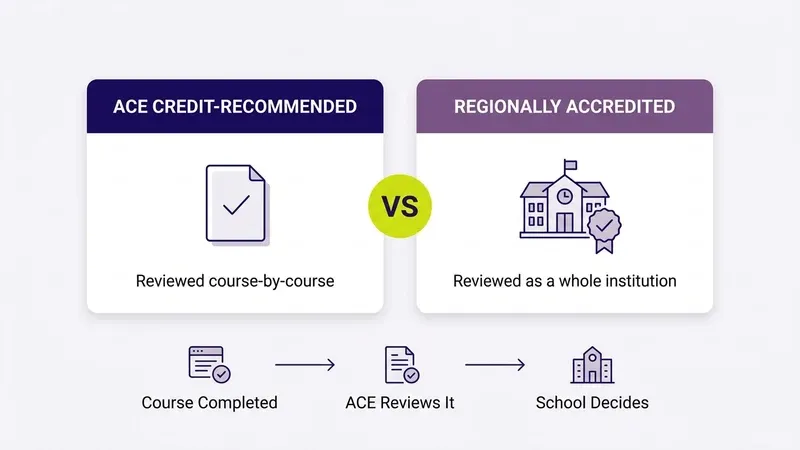
ACE Credit-Recommended
An outside reviewer says a course is college-level and recommends a credit amount. It applies to individual courses, and it's only a recommendation — no school is required to follow it.
Regionally Accredited
A recognized agency reviews an entire institution and its degree programs. It applies to schools, not single courses — which is why Sophia, a course provider, isn't eligible for it.
Colleges That Commonly Accept Sophia Credits
These are the schools students most often use Sophia with. The big three — WGU, SNHU, and Liberty — are the most Sophia-friendly, but plenty of others take the credits too.
| College | Notes |
|---|---|
| WGU (Western Governors University) | The most popular Sophia destination. Publishes Sophia-specific transfer pathways. Credits must be finished before you start. See our full WGU guide → |
| SNHU (Southern New Hampshire) | Accepts a large slate of Sophia courses toward gen-ed and electives; publishes a Sophia transfer list. |
| Liberty University | Accepts many Sophia courses; generous transfer allowance for online degrees. |
| GCU (Grand Canyon University) | Accepts Sophia for eligible lower-division and gen-ed requirements. |
| UMGC (University of Maryland Global Campus) | Commonly accepts Sophia toward gen-ed. |
| Purdue Global | Frequently accepts Sophia toward lower-division requirements — always confirm per program. |
| Arizona State University (ASU) | Accepts many Sophia courses through its online degree pathways — confirm per program. |
Sophia keeps its own "Find Your School" directory, and many partner schools publish course-by-course equivalencies. Use both, then verify with your registrar.
What Makes a College "Sophia-Friendly"
The schools above tend to share a few traits, and spotting them can help you size up a school that isn't on this list:
- They publish a transfer equivalency guide. If a school has a public page mapping Sophia courses to their own course codes, that's a strong signal they accept Sophia regularly, not as a rare exception.
- They're built around transfer and working-adult students. Competency-based and online-first schools (WGU is the clearest example) design their degree paths assuming students arrive with outside credit.
- The credit is for gen-ed, not for a licensed major. English Composition, Statistics, and Intro Psych transfer far more easily than anything tied to a licensing board.
- They don't require the course to be "in residence." Some programs require a minimum number of credits to be earned directly through the school — check for a residency requirement before counting on transfer credit for graduation.
None of this replaces asking your own registrar, but it explains why some schools show up on every "accepts Sophia" list and others never will.
How Many Sophia Credits Can You Actually Transfer?
Most schools cap total transfer credit at around 75% of the degree — and that cap is shared across all your transfer credit, not Sophia alone. In practice:
- SNHU accepts up to ~90 transfer credits (75% of a 120-credit bachelor's).
- Liberty allows up to ~75% of the degree from transfer.
- WGU similarly caps transfer near 75%, and reserves some upper-division "domain" courses that must be taken there.
Sophia is best for the lower-division and general-education portion of a degree — English composition, statistics, humanities, social sciences. The upper-division, major-specific courses usually have to be earned at your degree school.
Nursing and Other Big Exceptions
Not every program plays nicely with Sophia. Nursing is the strictest. For example, Chamberlain University does not accept Sophia credits for nursing prerequisites, citing the open-book, unproctored assessment model, the lack of an in-person lab component, and science-recency rules (prereqs like Anatomy & Physiology, microbiology, and chemistry often must be completed within ~5 years with a minimum grade).
If you're headed for a nursing, allied-health, or lab-science program, treat Sophia science prerequisites as high-risk and confirm in writing before enrolling.
Common Reasons Sophia Credits Get Rejected
Even at schools that generally accept Sophia, an individual credit can still get turned down. The usual culprits:
Watch out for these
- Grade minimums. Some schools only accept transfer credit above a certain grade (often a C or better) — check the threshold before you assume a passing Milestone is enough.
- Course overlap. If you've already earned credit for a similar course elsewhere, the school may reject the "duplicate" instead of stacking both.
- Credit age. A handful of programs won't accept transfer credit older than five or ten years, which mostly matters for science and math prerequisites.
- Program-specific bans. Licensure-track majors (nursing, education, some business programs) often carve out required courses that must be taken at the degree-granting school itself.
None of these are reasons to avoid Sophia — they're just the fine print worth reading before you pick which courses to take.
How to Confirm Your School Accepts Sophia (Do This First)
1 Check Sophia's school directory
Search Sophia's "Find Your School" tool and look for any published course equivalency list your school has put out. Many partner schools map Sophia courses directly to their own course codes.
2 Email your registrar or advisor
Send the exact Sophia course names, ACE IDs, and your specific degree program. Ask directly whether those courses will count toward your requirements — eligibility isn't the same as guaranteed acceptance.
3 Mind the timing
Some schools — WGU most notably — only count Sophia credits completed before you start your first term. Finish the course and submit your transcript first, then enroll.
4 Request your official transcript
Once you've completed a course, order an official transcript from Sophia and have it sent directly to your school's admissions or registrar office.
Finish Your Sophia Courses Faster
Here's the practical reality: Sophia is a flat $99/month, so the faster you finish, the less the whole degree costs — and if your school (like WGU) requires credits before you start, speed directly determines when you can enroll.
Sophia's Challenges and Milestones are open-book, unproctored, multiple-choice assessments — which is exactly where a study assistant helps. SolveHog reads your Sophia Milestone or Challenge question right on the page and surfaces the answer in one click, with optional step-by-step explanations so you actually learn it. It's built for Sophia answers and passing Milestones fast. (It doesn't do Touchstones — those are written and plagiarism-checked, and we're honest about that.)
Weighing Sophia against other credit providers? See how it compares to StraighterLine and Study.com.
Frequently Asked Questions
Is Sophia Learning accredited?
No. Sophia is not regionally or institutionally accredited — it offers individual courses, not degrees. Its courses are ACE credit-recommended, which many colleges accept, but the receiving school always makes the final decision.
How many Sophia credits will my college take?
Usually up to about 75% of your degree, and that cap is shared across all transfer credit. Sophia is best for lower-division and general-education requirements; upper-division major courses typically must be earned at your degree school.
Do nursing schools accept Sophia credits?
It's mixed and often restrictive. Some do, but others — like Chamberlain — do not accept Sophia for nursing prerequisites due to lab, proctoring, and science-recency requirements. Always confirm in writing before enrolling.
Does Sophia guarantee my credits will transfer?
No. An ACE credit recommendation makes a course eligible for transfer, but acceptance is decided per school and per program. Confirm with your registrar for your exact degree before you enroll.