Is Sophia Learning Legit?
Yes — Sophia Learning is a real, ACE-recommended credit provider, not a scam. But 'legit' has a catch worth understanding before you subscribe.

The Short Answer: Yes, Sophia Learning Is Legit
Sophia Learning is a legitimate company and a real credit-earning platform — not a scam, not a diploma mill, and not a fly-by-night website. Its self-paced online courses are recommended for college credit by the American Council on Education (ACE), the same credit-recommendation body that colleges across the country rely on to evaluate outside coursework.
Just as importantly, Sophia isn't some anonymous startup. Sophia Learning is owned by Strategic Education, Inc. (SEI) — a publicly traded company (NASDAQ: STRA) that also owns Strayer University and Capella University. That's a serious, established education company behind the product, which is a big part of why so many students find its credits accepted at their target schools.
So if the question is "will I get scammed?", the answer is no. But "legit" is doing some heavy lifting in that question, and the honest, useful answer is a little more nuanced. Let's unpack it.
What "Legit" Actually Means Here
When people ask whether Sophia is legit, they're usually asking one of three different things:
- "Is it a real company that will deliver what I pay for?" — Yes. You pay a flat monthly membership, you get unlimited access to real, structured college-level courses, materials included.
- "Are the credits real?" — Yes, in the sense that they're ACE credit-recommended. ACE reviews the course content and recommends how much credit it's worth and at what level.
- "Will my school actually accept them?" — This is the one with a catch. Sophia's credits are recommended for credit, but the receiving college always makes the final call.
That third point is the single most important thing to understand. Sophia can hand you a transcript that says a course is worth 3 credits at the lower-division level, but your university decides whether to apply those credits to your degree. Most Sophia-friendly schools do — that's the whole point of using it — but it's never automatic, and it varies by program.
An ACE credit recommendation is real, but it's a recommendation, not a guarantee — the receiving school always holds the final vote.
For the full picture on what ACE-recommended does and doesn't mean, read our companion post: Is Sophia Learning Accredited? It's the other half of this question, and it clears up the most common misconception.
Sophia Is Not Accredited — And That's Normal
Here's where a lot of "is it a scam?" fears come from: Sophia is not institutionally or regionally accredited. People see that, panic, and assume the whole thing is fake.
It isn't. Sophia says so openly itself — and the reason is simple: Sophia offers courses, not degrees. Accreditation is something that applies to institutions that grant degrees. Sophia doesn't grant degrees; it provides individual courses that you transfer into an accredited school's degree program. So the relevant credential for a course provider isn't accreditation — it's ACE credit recommendation, which Sophia has.
Think of it this way: Sophia is a legit credit supplier. Your accredited university is the degree provider. The two work together, and that's exactly how the system is designed to work.
Diploma Mills vs. ACE-Recommended Providers
The reason "is it legit" even comes up is that actual diploma mills exist, and they've made students rightly cautious. The good news is that a diploma mill and an ACE credit-recommended provider look nothing alike once you know what to check.
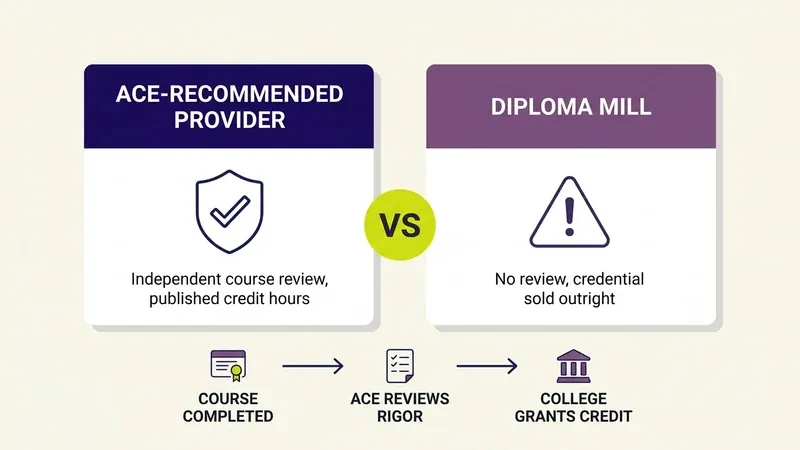
A diploma mill sells you a credential with no real coursework behind it: pay a flat fee, get a "degree" or "credits" with little to no independent review of what you actually learned. There's usually no third party evaluating course content, no published rigor standard, and often a deliberately vague or hidden ownership structure.
Sophia is the opposite on every count. Its course content goes through independent ACE review before any credit recommendation is issued, its parent company is a publicly traded, SEC-reporting business (Strategic Education, Inc., NASDAQ: STRA), and its courses map to specific, published learning outcomes — not a flat "pay and you're done" credential. That's the structural difference between "legit but has a nuance" and "not legit at all."
The Proof: Real Schools Accept Sophia Credits
The clearest evidence that Sophia is legit is that mainstream, accredited universities publish transfer pathways for it. Schools that commonly accept Sophia credits include:
- WGU (Western Governors University) — publishes Sophia-specific transfer pathways per college.
- SNHU (Southern New Hampshire University) — accepts a large block of transfer credit.
- Liberty University — accepts Sophia credit toward many programs.
- Plus GCU, UMGC, Purdue Global, and Arizona State, among others.
If Sophia were a scam, these institutions wouldn't be publishing course-by-course maps showing how its credits satisfy their requirements. For the complete, up-to-date list and how acceptance works school by school, see our pillar guide: What Colleges Accept Sophia Learning Credits?
One honest caveat worth flagging: not every school accepts Sophia, and some programs are strict. Nursing prerequisites are the classic example — some nursing programs won't accept Sophia's science courses because they're open-book and lack a lab component. Legit doesn't mean universally accepted. Always verify with your specific school's registrar before you buy.
How to Verify Sophia Is Legit Yourself
You don't have to take our word for it, or Sophia's marketing page's word for it. All of the following are things you can check yourself in about ten minutes, before you spend a dollar.
1 Look up the course in ACE's own database
ACE runs a public credit-recommendation registry. Search for a Sophia course by name and confirm it's actually listed with a recommended credit amount — don't just trust Sophia's site to tell you.
2 Confirm the parent company is real and public
Strategic Education, Inc. trades on NASDAQ under STRA. You can pull its SEC filings and investor materials directly — a company with public financial disclosure has a lot less room to run a scam.
3 Get your target school's answer in writing
Marketing pages say credits are "widely accepted." Your registrar's email is what actually counts. Ask about the specific course and your specific degree program before you enroll.
4 Read reviews from students who actually transferred
Look past the testimonials on Sophia's own site. Search Reddit, the Better Business Bureau, and Trustpilot for people describing what happened when they tried to transfer Sophia credits into a real degree.
Who Sophia Is Actually For (and When It's Worth It)
Sophia is worth it when you fit its use case — and a poor fit when you don't. It's a strong choice if you:
- Are transferring credits into an accredited degree at a Sophia-friendly school (WGU and SNHU are the sweet spot).
- Want to save money — Sophia is a flat $99/month for unlimited courses, which is dramatically cheaper than per-credit tuition if you can finish several courses quickly.
- Prefer self-paced, no-deadline, unproctored learning. Most courses take about 2–6 weeks, and you set the pace.
It's a weaker fit if your target school doesn't accept transfer credit generously, if you need lab-based science courses for a nursing or pre-health track, or if you thrive only with live instruction and structure.
The math is simple: because it's a flat monthly fee for unlimited courses, the faster you finish, the more value you extract. A focused month can clear several courses — and several courses at $99 total is a fraction of what the same credits cost in tuition.
Where SolveHog Fits In
Sophia's speed advantage is real, but the assessments still take time — and that's where a study assistant earns its keep. Sophia's Challenges and Milestones are open-book, unproctored, multiple-choice assessments. That's exactly the format a browser-based helper is built for.
SolveHog reads your Sophia Milestone or Challenge question right on the page and surfaces the answer in one click, with optional explanations so the concept actually sticks instead of just getting checked off. If you're using Sophia to move fast toward a degree, it helps you pass Sophia Milestones and finish Sophia fast so you get the most out of every $99 month.
To be clear about scope: SolveHog works on the open-book MCQ assessments. It doesn't touch Touchstones — those are written, human-graded, and plagiarism-checked, so we leave them alone. That honesty is part of using Sophia the right way.
The Bottom Line
Is Sophia Learning legit? Yes — it's a real, ACE-recommended credit platform owned by a major publicly traded education company, and its credits are accepted at plenty of accredited universities. Just remember the one nuance that trips people up: Sophia is legit as a credit provider, not as an accredited degree-granting school, and your receiving college always makes the final call on the credits. Fit it to a Sophia-friendly school and it's one of the best deals in higher education.
Frequently Asked Questions
Is Sophia Learning a scam?
No. Sophia Learning is a legitimate credit provider owned by Strategic Education, Inc. — the same publicly traded company (NASDAQ: STRA) that owns Strayer and Capella universities. Its courses are ACE credit-recommended and accepted at many accredited schools. It's a real product, not a scam.
Is Sophia Learning worth it?
For most transfer students, yes. At a flat $99/month for unlimited self-paced courses, it can clear general-education and lower-division requirements for a fraction of tuition — as long as your target school accepts the credits. It's worth the most when you finish quickly and when your receiving school (like WGU or SNHU) is Sophia-friendly.
Why isn't Sophia Learning accredited if it's legit?
Because accreditation applies to institutions that grant degrees, and Sophia only offers individual courses — not degrees. The right credential for a course provider is ACE credit recommendation, which Sophia has. You transfer the credits into an accredited school's degree program. See our full explainer on whether Sophia is accredited.
Will my college accept Sophia Learning credits?
Many will, but it's never automatic — the receiving school always decides, and it varies by program. WGU, SNHU, and Liberty are among the most Sophia-friendly, while some nursing and pre-health programs are strict. Always confirm with your school's registrar. Our pillar guide on what colleges accept Sophia credits covers it school by school.