Is Sophia Learning Accredited?
No — Sophia Learning isn't institutionally or regionally accredited. It doesn't need to be: what matters is its ACE credit recommendation, and here's exactly what that means for your transfer credit.


The Short Answer: No, Sophia Is Not Accredited
Let's be direct: Sophia Learning is not institutionally or regionally accredited. Sophia states this plainly itself, and any source telling you otherwise is wrong.
But before you close the tab and assume that's a dealbreaker — it isn't, and here's why. Accreditation is a credential for institutions that grant degrees. Sophia doesn't grant degrees; it offers individual courses that you transfer into an accredited school's degree program. So expecting Sophia to be "accredited" is a bit like asking whether a textbook publisher is accredited — it's the wrong question for what Sophia actually does.
The credential that does matter for a course provider is ACE credit recommendation, and Sophia has it. Understanding the difference between those two things is the whole ballgame, so let's break it down.
Accredited vs. ACE-Recommended: The Key Difference
These two terms get used interchangeably all the time, and that confusion is exactly what causes the "is Sophia accredited?" panic. They are not the same thing.
Accreditation is a quality-assurance stamp given to institutions — colleges and universities — by recognized accrediting bodies. It certifies that the whole institution meets standards to grant degrees. Regional accreditation (now often just called institutional accreditation) is the most widely recognized form.
ACE credit recommendation is different. The American Council on Education (ACE) reviews individual courses and training programs and recommends how much college credit each is worth, at what level (lower- or upper-division), and in what subject area. ACE doesn't accredit anything — it evaluates course content and publishes a recommendation that colleges can choose to honor.
Here's the clean way to hold it in your head:
- Accreditation answers: "Is this a legitimate degree-granting institution?"
- ACE recommendation answers: "Is this course worth college credit, and how much?"
Sophia is in the second category. Its courses have been reviewed by ACE and carry credit recommendations — which is precisely the credential a transfer-credit provider is supposed to have.
Accreditation certifies an institution; ACE recommendation certifies a course — Sophia only ever needed the second one.
What ACE-Recommended Actually Gets You
An ACE credit recommendation is meaningful, but it's important to be precise about what it does and doesn't do.
What it does: After you pass a Sophia course, you can request an official transcript. That transcript reflects ACE's credit recommendation for the course. Because thousands of colleges consult ACE's National Guide when evaluating outside coursework, that recommendation gives your credits real, recognized standing in the transfer process.
What it does not do: ACE cannot force any school to accept the credit. A recommendation is exactly that — a recommendation. The receiving college always makes the final decision about whether Sophia credits apply to your specific degree, and how many count.
This is why you'll see language like "ACE recommended" everywhere but rarely a flat guarantee of acceptance. The recommendation is the strong opening move; the receiving school's registrar makes the final call. For a fuller sense of why Sophia is still a trustworthy, real product despite not being accredited, see our companion piece: Is Sophia Learning Legit?
How a Sophia Course Actually Becomes Transfer Credit
It helps to see the whole pathway in one place, because "accredited or not" makes it sound like a single yes-or-no gate. It isn't — it's a four-step handoff between three different parties (Sophia, ACE, and your school), and understanding each link explains why the process feels slower or murkier than a normal college transcript.
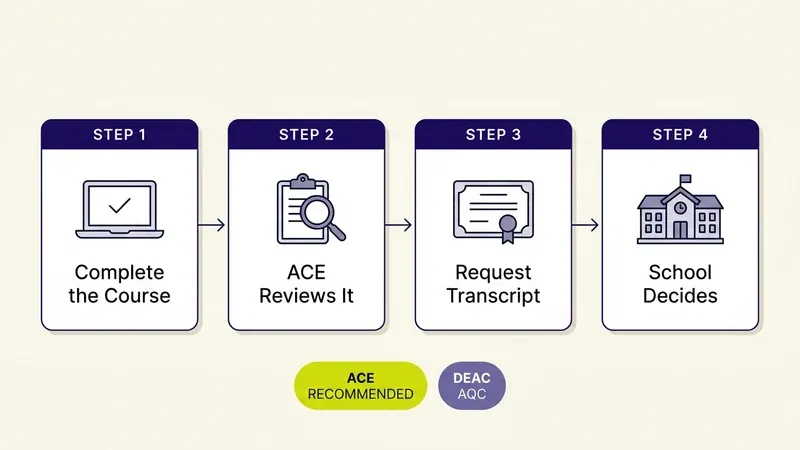
- You complete the course. You work through the Sophia course material and pass its Milestones and Touchstones — Sophia's own internal proof that you've mastered the content.
- ACE has already reviewed it. This step happened before you ever enrolled: ACE's reviewers evaluated the course's syllabus, learning outcomes, and assessments against college-level standards, and published a credit recommendation for it in the ACE National Guide. Your individual completion doesn't trigger a new review — it just means you're now eligible to claim the credit ACE already priced.
- You request your official transcript. Once you've passed the course, Sophia issues a transcript that documents your grade and cites the ACE-recommended credit and level for that course.
- Your school's registrar decides. The receiving school checks the ACE recommendation against its own degree requirements and either accepts the credit, accepts a partial amount, or declines it. This step is entirely outside Sophia's and ACE's control — it's a policy call made by the institution that's about to put its name on your degree.
Framed this way, "is Sophia accredited?" is really a question about step 4, not step 1. The course was already vetted; what's left is whether a specific institution has decided to trust that vetting for a specific requirement.
What About DEAC? A Note on the Nuance
There's one more layer worth mentioning so you get the complete picture. Beyond ACE, a subset of Sophia's courses also hold DEAC Approved Quality Curriculum (AQC) status.
DEAC (the Distance Education Accrediting Commission) is a recognized accrediting body, and its AQC designation is a curriculum-quality approval — it vouches for the quality of specific course curriculum. It is not institutional accreditation of Sophia as a whole, and it applies only to a portion of the catalog rather than every course. It's a genuine mark of quality, but don't let anyone spin it into "Sophia is accredited." It isn't; some of its courses simply carry an additional curriculum-quality approval on top of the ACE recommendation.
Is Sophia Regionally Accredited? (No — and Why It Doesn't Block Transfer)
"Is Sophia regionally accredited?" is one of the most common phrasings of this question, so it deserves a direct answer: no, Sophia is not regionally accredited. Regional (institutional) accreditation applies to degree-granting institutions, and again — Sophia grants no degrees.
Students worry about this because regional accreditation is what lets credits transfer between traditional universities. But Sophia doesn't rely on that mechanism. Its credits move through the ACE credit-recommendation pathway instead: you earn the course, ACE's recommendation gives it standing, and your accredited school evaluates it for transfer. Plenty of regionally accredited universities — WGU, SNHU, Liberty, and others — accept Sophia credits precisely through this route. The lack of Sophia's own regional accreditation doesn't block the transfer; the ACE recommendation is the vehicle.
The practical takeaway stays the same as everywhere else: eligibility is not a guarantee. Whether your specific school accepts a specific Sophia course for a specific degree is something only that school's registrar can confirm. Our pillar guide walks through the schools that commonly accept Sophia and how to check: What Colleges Accept Sophia Learning Credits?
Why This Distinction Matters for Your Money
Getting this right isn't just academic hair-splitting — it protects your wallet and your timeline. If you assume "not accredited" means "worthless," you might pass up one of the cheapest legitimate ways to earn transferable credit. And if you assume "ACE recommended" means "guaranteed to transfer everywhere," you might buy courses your target school won't accept.
The correct mental model sits in the middle: Sophia's courses are ACE credit-recommended and widely accepted, but always confirm acceptance with your receiving school first. Do that, and you can confidently use Sophia's flat $99/month membership to knock out real credit for a fraction of tuition.
How to Verify Sophia's Credentials Yourself
Don't take any single source's word for it — including this article. Sophia's ACE and DEAC status are both publicly checkable in a few minutes.
1 Look up the course in ACE's National Guide
ACE publishes its credit recommendations in a searchable National Guide. Search for the specific Sophia course name and confirm the recommended credit hours and level match what Sophia advertises.
2 Check DEAC's Approved Quality Curriculum list
If a course is marketed with DEAC AQC status, DEAC maintains its own public directory of approved curricula. Confirm the specific course appears there rather than assuming the whole catalog is covered.
3 Ask your registrar which credential they actually use
Some schools evaluate transfer credit purely off the ACE recommendation; others want the official Sophia transcript in hand first. Ask which one starts the process at your school.
4 Get the acceptance in writing
A verbal "yes, we usually take those" from an advisor isn't binding. Ask for written confirmation — an email referencing the specific course and your degree program is enough — before you pay for anything.
Common mistakes students make here
- Assuming "ACE recommended" means "my school accepts it." It only means the course is eligible to be considered — nothing more.
- Confusing DEAC AQC with institutional accreditation. AQC is a curriculum-quality mark on specific courses, not proof that Sophia itself is an accredited school.
- Skipping the registrar check because a sibling site says a school "accepts Sophia." Policies vary by program within the same university, especially for science and licensure-track majors.
- Enrolling before confirming timing rules. A few schools, including WGU, only count Sophia credit completed before your first term — verify this before you start a course, not after.
Where SolveHog Fits In
Once you've confirmed your school accepts Sophia and you're ready to move, the goal becomes finishing efficiently — because Sophia charges a flat monthly fee, so speed equals savings. Sophia's Challenges and Milestones are open-book, unproctored, multiple-choice assessments, which is exactly the format a study assistant is built for.
SolveHog reads your Sophia Milestone or Challenge question on the page and surfaces the answer in one click, with optional explanations so the material sticks. It helps you pass Sophia Milestones and finish Sophia fast so every $99 month covers more ground. It doesn't touch Touchstones — those are written and plagiarism-checked, so we leave them alone.
The Bottom Line
Is Sophia Learning accredited? No — not institutionally, not regionally, and it isn't supposed to be, because it offers courses rather than degrees. What it does have is ACE credit recommendation (and DEAC AQC status on a subset of courses), which is the correct and meaningful credential for a transfer-credit provider. The recommendation gives your credits real standing, but the receiving school always makes the final call. Understand that, verify with your target school, and Sophia becomes one of the smartest credit deals available.
Frequently Asked Questions
Is Sophia Learning accredited?
No. Sophia Learning is not institutionally or regionally accredited, because it offers individual courses rather than degrees. Instead, its courses are ACE credit-recommended — the appropriate credential for a transfer-credit provider — and a subset also hold DEAC Approved Quality Curriculum status.
Is Sophia Learning regionally accredited?
No, Sophia is not regionally (institutionally) accredited. Regional accreditation applies to degree-granting institutions, and Sophia grants no degrees. Its credits transfer through the ACE credit-recommendation pathway instead, which is how regionally accredited schools like WGU and SNHU are able to accept them.
What's the difference between accredited and ACE-recommended?
Accreditation certifies an institution to grant degrees. ACE credit recommendation evaluates an individual course and recommends how much college credit it's worth. Sophia has the second, not the first — which is exactly what a course provider should have. ACE can't force a school to accept the credit, though; the receiving college always decides.
If Sophia isn't accredited, are its credits worthless?
No. ACE-recommended credits have real, recognized standing and are accepted at many accredited universities, including WGU, SNHU, and Liberty. "Not accredited" simply means Sophia is a course provider, not a degree-granting school. Just always confirm acceptance with your specific school — see our guide on whether Sophia is legit for the bigger picture.