How Does Sophia Learning Work?
Sophia Learning is a flat $99/month subscription for self-paced, ACE-recommended college courses — no deadlines, no per-course fees. Here's exactly how the courses, assessments, and credit transfer work, start to finish.

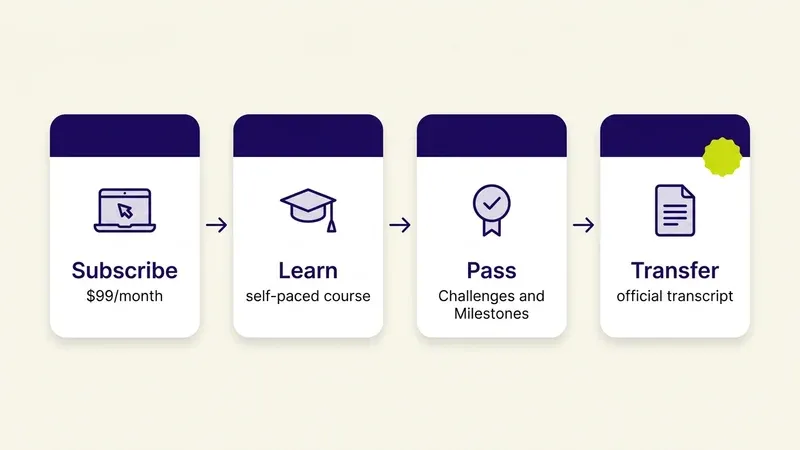
The Short Version: Subscribe, Learn, Pass, Transfer
Sophia Learning is a subscription-based platform for self-paced, ACE credit-recommended college courses. You pay a flat monthly fee, take as many courses as you want during that month, pass the assessments in each course, and then request an official transcript to send to the college where you actually earn your degree.
There are no per-course charges, no semesters, and no deadlines. It's often described as "Netflix for college credit" — one membership, unlimited access, learn at your own pace. The catch is that Sophia itself doesn't grant degrees; it produces transferable, credit-recommended coursework that your school decides to accept. Let's walk through each stage.
Sophia isn't selling you a degree — it's selling you time. You're paying for a month, not a course, so the entire strategy comes down to how much you finish before the billing cycle resets.
The Cost: A Flat $99/Month, No Per-Course Fees
Sophia runs on a flat $99/month membership, billed month-to-month, cancel anytime. That single price covers unlimited courses and includes all the learning materials — there are no textbooks to buy and no per-course fees stacked on top.
This pricing model is the whole strategy. Because you're paying for time rather than per course, your goal is to finish as many courses as you reasonably can within each billing month. A focused, motivated student can complete several courses in a single $99 month, which is what makes Sophia one of the cheapest ways to clear general-education requirements before transferring them in.
Self-Paced With No Deadlines
Sophia courses are fully self-paced. There's no cohort, no weekly due dates, and no professor waiting on submissions. You open a course, move through it as quickly (or slowly) as you like, and the clock is really just your own monthly subscription.
A typical Sophia course takes somewhere in the range of two to six weeks for most students, but that's an average, not a rule — some people finish a course in days. Because there are no deadlines, your pace is entirely a function of how much time you put in, which is why "finish fast" is such a common Sophia strategy.
There's also a no-card free trial that lets you preview the platform up to the first Challenge, and any work you complete during the trial carries over if you subscribe — so you can see how a course is structured before you pay. Note that there's no free first month; once you subscribe, the flat $99/month applies from day one.
The Four Assessment Types (This Is the Important Part)
Every Sophia course is built from the same four assessment types. Understanding how each one is graded, whether it's open-book, and how many attempts you get is the single most useful thing to know before you start.
Challenges (Practice)
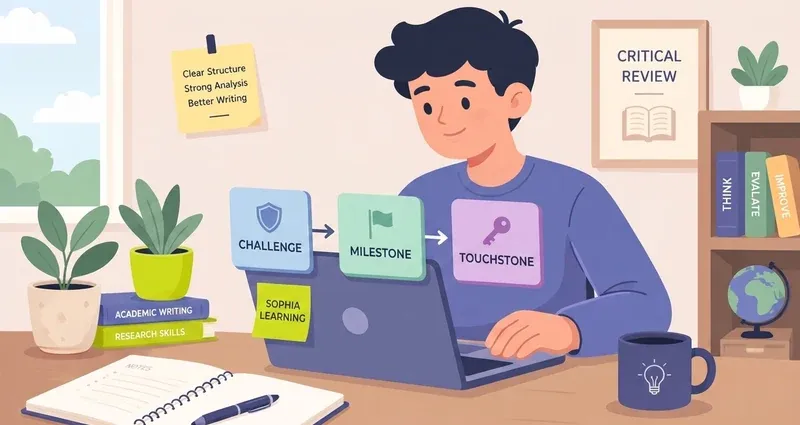
Challenges are short, low-stakes practice assessments — usually five to ten multiple-choice questions — that appear throughout a unit to check your understanding as you learn. They're open-book, lightly graded, and you get three attempts per topic (your coach can reset an attempt once if needed). Think of Challenges as guided practice: they prepare you for the graded Milestone at the end of the unit.
Milestones (Graded Unit Assessments)
Milestones are the graded, end-of-unit assessments and they carry real weight — roughly three times that of a Challenge. They're multiple-choice, open-book (open-note), and timed to a single sitting. Crucially, Milestones are retakable, and Sophia keeps your highest score — so a rough first attempt doesn't sink you. Milestones are unproctored, which is worth understanding in detail before an exam; we cover that fully in is Sophia Learning proctored?.
Touchstones (Written and Project Work)
Touchstones are the outlier: instead of multiple choice, they're written assignments or projects that a human grader scores against a rubric. They're take-home, you can resubmit if you need to revise, and — importantly — Touchstones are checked for plagiarism and must be your own original work under Sophia's Academic Integrity Policy. Not every course has them; if you specifically want a faster, milestone-only path, see Sophia courses without Touchstones.
Final Milestone (The Final Exam)
The Final Milestone is the course's cumulative final. Like a regular Milestone, it's multiple-choice, open-book, unproctored, and retakable. You pass with a score of 50% or higher. Clear the Final Milestone and you've completed the course.
Inside a Typical Unit: How the Material Is Organized
Every Sophia course is broken into a handful of units, and each unit follows the same rhythm — once you recognize it, you can move through the platform much faster.
1. Read or Watch
Each topic opens with short readings, videos, or interactive tutorials that introduce the concept. It's designed to be consumed in one sitting, not a multi-hour lecture.
2. Practice with a Challenge
After the material, you hit a low-stakes Challenge to check whether it stuck. Get it wrong and you can revisit the content and try again — that's the point.
3. Repeat Across Topics
A unit usually contains several topics, so this read-then-Challenge loop repeats a handful of times before you reach the end of the unit.
4. Clear the Milestone
Once every topic in the unit is done, the unit Milestone becomes available. Pass it and the next unit unlocks; the course ends when you clear the Final Milestone.
This structure matters for pacing: because Challenges are unlimited practice and Milestones are the only assessments that actually count, the fastest students spend less time re-reading and more time using Challenges as a diagnostic — if you're breezing through them, you're ready for the Milestone; if you're not, that's your signal to slow down before it's graded.
Your coach — every Sophia student is assigned one — can also reset a Challenge attempt or answer questions about where you're stuck, so you're not entirely on your own between units.
How Sophia Credits Turn Into Real College Credit
Passing your courses is only half the equation — the other half is transfer. Here's the chain:
- Sophia courses are ACE credit-recommended. The American Council on Education (ACE) reviews Sophia's courses and recommends a specific number of credits at a specific level. (A subset of courses also hold DEAC curriculum approval.)
- You finish the course by passing all its assessments, including the Final Milestone.
- You request an official transcript from Sophia and have it sent to your target college.
- Your school decides whether to accept it. ACE recommendation is not the same as accreditation — Sophia is not regionally accredited, and the receiving school always makes the final call on how the credit applies to your degree.
That last point matters: "ACE-recommended" means many colleges accept the credit, but eligibility isn't a guarantee for every program. Always confirm with your school's registrar for your specific degree. For the full breakdown of which schools accept Sophia and how to check, start with our pillar guide, what colleges accept Sophia Learning credits?
Worth knowing up front: Sophia is owned by Strategic Education, Inc. — the same parent company behind Strayer University and Capella University — and its courses have been used to save students over a billion dollars in tuition. That corporate backing is part of why so many schools have published Sophia-specific transfer pathways. Still, some programs are restrictive: nursing prerequisites in particular (anatomy, microbiology, chemistry) are the highest-risk category, and certain schools won't accept them, so those are always worth verifying first.
Common Mistakes First-Time Sophia Students Make
Most of the ways students waste time or money on Sophia trace back to a handful of avoidable mistakes:
Watch out for these
- Starting a course before confirming your school accepts it. Finishing a course you can't actually transfer is the single most expensive mistake — check with your registrar before you enroll, not after.
- Letting the subscription run without a plan. Because billing is monthly regardless of how much you finish, an idle month is money spent with nothing to show for it. Line up your next course before the current one ends.
- Treating Challenges as optional. Skipping straight to the Milestone might feel faster, but Challenges are unlimited and ungraded — using them as real practice lowers your odds of burning a Milestone attempt on a concept you hadn't actually learned yet.
- Missing the timing rule for schools like WGU. Some schools only count Sophia credit completed before your first term starts. Finishing a course after you've already enrolled can mean it doesn't count at all.
- Assuming every course has the same assessment mix. Not every course includes a Touchstone, and the ones that do require original written work — plan extra time for those instead of budgeting every course the same way.
None of these are reasons to avoid Sophia — they're just the fine print worth reading before your first login.
Where SolveHog Fits In
Because Sophia's Challenges and Milestones are open-book, unproctored, multiple-choice assessments, they're exactly the kind of work a study assistant is built for. SolveHog is a Chrome extension that reads the Sophia Milestone or Challenge question on your screen and surfaces the answer in one click, with optional explanations so the concept actually sticks as you move fast through a course.
To be clear about scope: SolveHog helps with the open-book multiple-choice assessments — Challenges, Milestones, and Final Milestones. It does not touch Touchstones, because those are written, human-graded, and plagiarism-checked. If your aim is to move efficiently through the multiple-choice portion of a course, that's what it's for.
Frequently Asked Questions
How much does Sophia Learning cost?
Sophia is a flat $99 per month, billed month-to-month with no per-course fees and no textbook costs. One membership gives you unlimited access to courses during that month, so finishing several courses in a single billing cycle is the most cost-effective way to use it.
What are Touchstones in Sophia Learning?
Touchstones are Sophia's written assignments and projects — the non-multiple-choice assessments. A human grader scores them against a rubric, you can resubmit revisions, and they're checked for plagiarism, so they must be your own original work. Not every Sophia course includes Touchstones.
How long does a Sophia course take?
Because courses are self-paced with no deadlines, timing depends entirely on you. Most students finish a course in about two to six weeks, but a focused student can move much faster — the only real clock is your $99 monthly subscription.
Do Sophia credits transfer to my college?
Sophia courses are ACE credit-recommended and accepted at many colleges, but Sophia is not itself accredited, so acceptance is never automatic. You pass the course, request an official transcript, and your school decides how the credit applies. Always confirm with your target school's registrar before enrolling.