Sophia Learning Courses Without Touchstones
Touchstones are the written, human-graded assignments that slow a Sophia course down. Here's how to find Milestone-only courses and skip the wait.


What Touchstones Actually Are
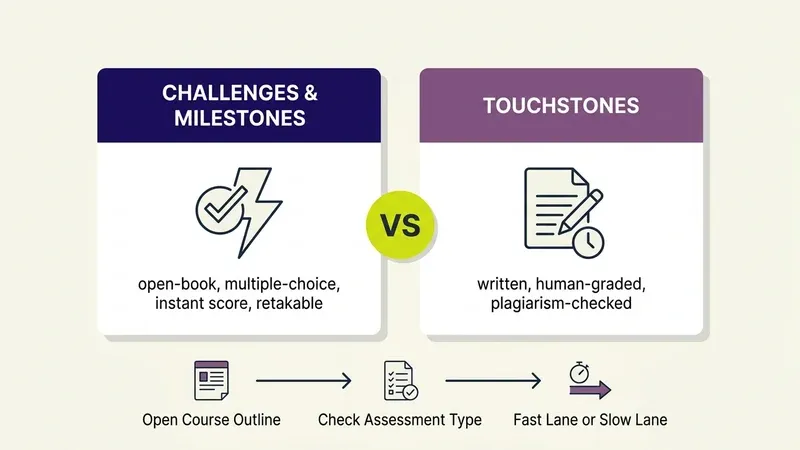
If you've spent any time in Sophia Learning, you already know the three kinds of work you run into: Challenges, Milestones, and Touchstones. The first two are multiple-choice. Touchstones are the odd one out — they're written or project-based assignments, submitted take-home, and graded by a human against a rubric.
That human-graded part is the whole story. A Touchstone isn't something you answer and instantly see a score for. You draft it, submit it, and then wait for a grader to read it and either pass it or send it back for revision. And because Touchstones are original written work, Sophia runs them through a plagiarism check under its Academic Integrity Policy — the submission has to be your own writing, every time.
So while Challenges and Milestones are open-book, multiple-choice assessments you can move through quickly, Touchstones are the deliberate, slow, evaluated part of a Sophia course. That difference is exactly why so many students search for Sophia Learning courses without Touchstones.
Why Students Want to Avoid Touchstones
Nobody's avoiding Touchstones because they're hard, exactly. They avoid them because of what they cost you:
- Time. Writing an essay or building a project takes far longer than answering a set of multiple-choice questions.
- Waiting. A Touchstone has to be graded by a person. Even with fast turnaround, you're no longer in control of your own pace — you're waiting on someone else. For a platform whose entire pitch is "finish as fast as you want," that's the one real bottleneck.
- Revisions. If a Touchstone comes back below the rubric, you rewrite and resubmit, which restarts the clock.
- Plagiarism risk. Because they're checked for originality, you can't reuse or lean on outside text. It has to be genuinely your own work.
Sophia is a flat $99/month membership with unlimited courses (confirm the current price on sophia.org before you subscribe), so your real cost is measured in time, not per-course fees. Every day a Touchstone sits in a grading queue is a day you're paying for. If your goal is to clear as many credits as possible inside one paid month, Milestone-only courses are the fastest lane — and that's what the rest of this guide is about.
The Fastest Path: Milestone-Only Courses
A Milestone-only course is exactly what it sounds like — a Sophia course whose graded assessments are all Milestones (plus their practice Challenges), with no Touchstone assignment to write.
That matters because of what Milestones are. Per Sophia's own test-taking guidance, Milestones are open-book, multiple-choice, and retakable — the highest score is kept. There's no live proctor, no webcam, and no essay. You study the unit, take the Milestone, and you know your result immediately. A Milestone-only course is therefore a stack of open-book multiple-choice assessments from start to finish — no waiting on a human grader anywhere in the path.
For a student trying to move fast, that's the ideal shape of a course:
- Instant feedback — you see your score the moment you submit, instead of waiting on grading.
- Retakes — if a Milestone doesn't go your way, you can retake it and keep the higher score.
- Full control of your pace — nothing in the course depends on someone else's queue.
- Open-book by design — Sophia intends for you to have your notes and materials in front of you.
If you want the mechanics spelled out end to end — Challenges vs. Milestones vs. Touchstones, how grading and retakes work — start with how does Sophia Learning work.
How to Identify Milestone-Only Courses
Sophia doesn't hand you a single filter labeled "no Touchstones," so you have to check each course before you commit time to it. Here's the reliable way to do it:
- Open the course outline first. Before you start any coursework, look at the course's list of units and assessments. Sophia lays out what each course contains up front.
- Scan the assessment types. You're looking for the word Touchstone. If every graded item is a Challenge or a Milestone and there's no Touchstone listed, you've found a Milestone-only course.
- Watch for the Final Milestone. Many courses end in a Final Milestone — that's still multiple-choice and open-book (you pass at 50% or above), so it's not a Touchstone and doesn't slow you down.
- Note how many Touchstones there are. Some courses have one; some have several. Even a single Touchstone changes the course's pace, so it's worth knowing before you begin.
- Cross-check what actually transfers. Pick courses that both fit your Milestone-only preference and count toward your target degree. Speed is pointless if the credit doesn't transfer.
The habit that saves the most time is simple: read the outline before you buy in. Two minutes of scanning tells you whether a course is a fast Milestone-only run or a slower one with written work.
How Touchstone Grading Actually Works
Knowing why Touchstones take longer makes it easier to plan around them. A Touchstone doesn't move through Sophia's system the way a Milestone does — it goes through a queue, not an algorithm.
1 You submit the assignment
You write or build the deliverable — an essay, case study, or project — and submit it through the course. Unlike a Milestone, there's no instant score screen; the submission just enters a grading queue.
2 A human grader reviews it against a rubric
A trained grader reads the submission and scores it against a published rubric, checking it for originality along the way. Turnaround depends on grader volume, not on how fast you wrote it.
3 You get a pass, or a revision request
If it clears the rubric, the Touchstone is complete. If it doesn't, you get feedback and a chance to revise and resubmit — which restarts the review clock.
A Touchstone doesn't test what you know today — it tests whether a grader agrees with how you explained it, on their schedule, not yours.
That's the real difference between a Milestone and a Touchstone: one is a knowledge check you control end to end, and the other is a review cycle you can only speed up by writing well the first time.
An Honest Note: Touchstones Still Exist in Many Courses
Here's the straight version, because it matters: plenty of Sophia courses do include Touchstones, and you can't always route around them. Some subjects — especially writing-heavy or project-oriented ones — are built around written assignments, and there's no Milestone-only alternative that covers the same requirement.
So "courses without Touchstones" is a real and useful filter, not a magic bypass. The smart move is to front-load the Milestone-only courses — clear them quickly to build momentum and stretch the value of your paid month — and then budget realistic time for the courses that genuinely require a Touchstone. If a required course has a written component, that component is the work, full stop. It's written, take-home, and plagiarism-checked, and it has to be your own.
Common Mistakes When Hunting for Milestone-Only Courses
Students chasing a fast Milestone-only run tend to make the same handful of mistakes. Watch for these before you commit your study time to a course:
- Judging a course by its title alone. "Introduction to X" sounds light, but plenty of intro-level courses still carry a Touchstone. The title tells you nothing about the assessment mix — the outline does.
- Trusting what worked in a different course. Sophia's catalog changes over time, and assessment structure varies by subject. A course that was Milestone-only for a friend last term may not be the same today.
- Ignoring a single, low-weight Touchstone. Even one Touchstone changes your pace, since you're now waiting on a human grader no matter how many Milestones surround it. "Mostly multiple-choice" is not the same as "no Touchstone."
- Picking speed over transfer value. A Milestone-only course you can clear in a weekend is worthless if it doesn't map to a requirement at your target school. Confirm transfer fit before you confirm speed.
- Starting before reading the outline. Discovering a Touchstone halfway through a course costs far more time than the two minutes it takes to check the outline first.
Avoiding these is mostly a matter of checking the outline before you commit — the same habit that identifies a Milestone-only course in the first place.
Where SolveHog Fits
Milestone-only courses are pure open-book, unproctored, multiple-choice — which is precisely the kind of assessment a study assistant is built for. SolveHog is a Chrome extension that reads your Sophia Milestone or Challenge question right on the page and surfaces the answer in one click, with optional explanations so the concept actually sticks instead of just getting checked off.
That makes the fast lane even faster: pick your Milestone-only courses, and let SolveHog help you move through the open-book multiple-choice at a steady clip. If your goal is to pass Sophia Milestones and finish fast before a transfer deadline, that's exactly what it's for.
One thing it deliberately doesn't do: Touchstones. Those are written, human-graded, and plagiarism-checked, so they're not something an answer assistant should — or does — touch. SolveHog stays in the open-book multiple-choice lane where it belongs, which is also the lane you want to be in if speed is the goal.
Frequently Asked Questions
What is a Touchstone in Sophia Learning?
A Touchstone is a written or project-based assignment submitted take-home and graded by a human against a rubric. Unlike Challenges and Milestones — which are open-book, multiple-choice, and scored instantly — Touchstones are original work that Sophia checks for plagiarism, and they can be sent back for revision.
Do all Sophia courses have Touchstones?
No. Some Sophia courses are Milestone-only, meaning every graded assessment is a Challenge or Milestone with no written Touchstone. Many other courses, especially writing- or project-heavy subjects, do include Touchstones. Always open the course outline and scan the assessment list before you start.
How do I find Sophia courses without Touchstones?
Open the course outline before committing and look at the assessment types. If the graded items are all Challenges and Milestones — including a Final Milestone, which is still multiple-choice — and no Touchstone is listed, it's a Milestone-only course. Also confirm the course counts toward your target degree.
Can SolveHog help with Touchstones?
No, and by design. Touchstones are written, human-graded, and plagiarism-checked, so an answer assistant isn't the right tool for them. SolveHog helps with Sophia's open-book, unproctored, multiple-choice Challenges and Milestones — the assessments that make up Milestone-only courses.